After completing the editing for the music video I shot in the studio, I gathered a group of my peers that I consider to also be 'music nerds'. I chose four of my friends, all in which are arts students at Russell group universities themselves, so I wanted their educated opinion on the art I created.
I chose for my arts students friends to give me feedback because I knew they'd understand the work a lot more because they will have studied something similar, or even more outrageous pieces, before. They already have knowledge and experience with films like these. Though it may sound elitist and pretentious, I didn't choose a passive, relaxed audience to give me feedback. This is mainly because they weren't my target audience anyway.
My demographic was split between male and female and all four were of similar ages. This is because the main target audience for alternative (good) music is young adults/adults and although music is male dominated, women make up a significant amount of the fanbases, despite not many actually being musicians.
I received a variety of responses:
Jenny W (20 - student at the University of Birmingham for Art History)
'You definitely achieved the monochrome look Yoko had in the 60s. I even got it before you said. It looks like something John and Yoko would have done. They would've made a minimal piece of work to make the audience think for themselves, rather than forcing something to heavy of a meaning to the viewers. One thing I'd say is that adding maybe a grainy filter would have helped add to the nostalgia and realism.'
Lee S (19 - student of History and French at Manchester)
'I can see why someone would think it is boring but I really liked it. It did drag a bit but the fact that it always looked like something was going to happen made it more interesting. The main part that interested me was thinking that you were going to do something or say something, maybe even start singing. But the fact that we were just left to feel however we wanted to feel about the video, that was pretty good. The visuals fit with the song fantastically, I loved it.'
Jamie F (19 - student of History at Oxford University)
'It looks to a really high standard and quite professional and I think the main reason you were able to achieve that is because you didn't aim to do an awful lot in your video. I think this video is a great example of the whole 'less is more' saying, because I think if you tried to do anything more to it that it could look tacky or really obviously like a project rather than a professional music video.'
Tash M (20 - student of Politics at Sussex)
'This video is really aesthetically pleasing and you did a really good job in making it look similar to Yoko. It would have been a pretty cool idea though if maybe you had a variety of models and said it was maybe linked to like the Beatles' wives at the time because it would've added a little bit of variety to the video and would probably make it easier for someone from a non, like, artsy background to watch. Or maybe subtitles about like thoughts to do with the song, that would've maybe added just a bit more to it.'
Conclusion of findings from focus group
In conclusion, the response for my music video was positive. The only negative response was that it could be perceived as boring, which I expected anyway. Even I manage to find watching it boring, but that is because it isn't meant to be an easy watch.
My focus group is technically a poor representation of what the general public would think of my music video. This is due to the people I asked being of the same age range, same ethnicity, same class background and having the same artistic/cultural interests. However, as my intended audience is artistic young people (young people because they are the main target audience for music videos anyway), I feel like my focus group selection is good and a good representation of what artsy individuals will think of my video.
Showing posts with label Unit 2 - Research Techniques. Show all posts
Showing posts with label Unit 2 - Research Techniques. Show all posts
Thursday, March 21, 2019

Music Video Analysis: C'mon Billy - PJ Harvey
Much like St Vincent's music video I previously analysed, PJ Harvey's music video for her 1995 single from To Bring You My Love is a spectacle. The mise-en-scene is on point, the acting from her is perfect and it is shot spectacularly. The song itself is about a woman who is begging for her partner to return (where he is is undisclosed, whether he left her for another woman or is at war etc is not confirmed) and meet his son. It is a desperate cry for him to come back.
The first shot shown in the music video is close-up shot of a man in a cowboy hat playing the violin. Though it may seem insignificant, this shot sums up the genre of the track. It has bluesy-country sounds to it, whilst having a melancholic string section to it. We then see Polly in a satin lilac dress and feather boa - an outfit that is reminiscent of a sex worker in western times, which is abundantly the role Polly plays in this video. Interestingly enough, even though she plays a character who is a sex worker, she still remains not excessively sexualised (unlike most music videos today). She is surrounded by men and behaves in a seductive way towards them.
This entire scene contrasts greatly against the next scene in Polly's bedroom. We have a birds-eye-view shot of her bed as she lies down, in her underwear, singing about the man she misses. Her loneliness and lack of men surrounding her contrasts greatly from when she was at the bar (?). We then see Polly standing in a dark room with one small lit square on her face as she changes into a loosely fitting shirt which we can only assume belongs to the partner she misses. Her makeup is greatly smudged, fitting into the high emotions she must be feeling at the moment. She slides down the wall, her face leaving the lit box, to then sit and watch footage of her and her partner. The footage is very pure and happy, whereas Polly's reaction shots are very dead and unhappy. In the footage she is smiling and lifelike, whereas the Polly watching the video is a completely different person.
After a brief few shots of the home footage, a sudden jump is made in the narrative of the music video. Polly has captured the man she is singing about and has managed to tie him up in a way so that his arms are embracing her. This is a very literal metaphor for her managing to make him stay and make him love her. As the song is already a desperate cry for him to return, it seems Polly has to take desperate measures to make him come back. An important thing to note is that Polly's child isn't present at all throughout the video aside from in the old home videos. Perhaps, her partner only stayed because they had a baby and now the baby is no longer there, he feels there was no reason to stay.
Monday, March 11, 2019
Questionnaire results
The first piece of research I conducted was a very short, brief questionnaire on www.surveymonkey.com
I chose to do a short, brief survey because I felt like a quantitative form of data would be easier to analyse in the end. It was also easily accessible to a larger group of people as it wasn't a survey asking people to listen to three 5 minute long songs and asking for their in-depth opinion about them. Due to this, I was able to get a fair few responses. Though not as in-depth as some, I still gained a lot of response to work with.
I provided a link on my social media accounts, of which don't have the biggest outreach because my social medias are all private, and received 31 responses which I think is a good amount. Due to the only people I asked being the people from my social media, it would imply that my demographic is mainly alternative music fans bar maybe two or three people who took it. It also means that the main age demographic is 17-20 year olds, aside from one person. Due to this, it could be argued that my survey isn't an accurate representation of a mainstream audience - which is completely right, however I wouldn't want my music video to appeal to a passive, mainstream audience.
The first question I asked was; What genre of music do you prefer?
 My findings for this question were that more people prefer classic rock suck as The Beatles and Led Zeppelin, etc. In second place was rap music. These two were no surprise as these were the most popular genres of music out of the five. The purpose of me asking this question was to help me understand what kind of song for a music video my audience would prefer.
The second question I asked was; What gender do you identify as?
 Though this question doesn't necessarily host any direct relevancy to the music, I felt that it would be relevant in understanding my outreach and the demographic of people I am focussing on. And, as no surprise, music remains male dominated for both fans and creators.
The third question I asked was ; What kind of music video do you prefer?
 This question was incredibly relevant to my research, as I was torn between making a performance-based music video with someone acting as the artists chosen or the projector/artsy/visual style music video. I included the option of story-based to allow people to vote for it as I knew that it would be something people would prefer. Even still, more people preferred the option I originally intended to go for anyway, thus further encouraging me to pursue my original idea.
My fourth question was ; Which decade do you feel had the best music?

I asked this question because it would help me narrow down what song to use and it would also help me narrow down what era's music videos to analyse. Though 80s had the strongest outcome, I chose to mainly analyse music videos from the 90s and 2000s. This is due to these music videos being easier to recreate (as it is the most recent eras out of the ones available) and I started the analysis before beginning my research.
My fifth question was ; Do you watch music videos?
 I asked this question to allow me to understand if music videos are actually still relevant in today's society. Music videos are something I personally thought were outdated as channels like MTV and 4music are hardly relevant today, and MTV doesn't even show music videos as much as they used to. I also thought because of the rise in streaming platforms, music has become a lot easier to listen to and the need for music videos was no longer a thing. However, I was wrong, and it is proven by my findings above. People still watch music videos on youtube.
The sixth question I asked was ; Does the quality of music video impact whether or not you like the song?
 I asked this question to gain a little bit more insight onto what people thing about music videos and what they want to see. My results suggest that music videos are still relevant, but just not as important. Music videos act as a nice addition to a song as opposed to being the main reason why someone would like it. Music videos have a far more promotional purpose.
The seventh question I asked was ; Do you prefer it when a song has a special meaning to you or would you rather they be more of a story being told by the artist about their lives?
 I found from this question that my music video should remain not heavily narrative based as it could be. It won't allow my audience to be able relate to them and develop a meaning specific to themselves, which is what people seem to prefer from my findings.
The eighth question I asked was ; Out of the two, which style of music video do you prefer?
 Asking this question allowed me to understand whether or not I would create a performance based music video or a more artistic video. I didn't provide the option for a narrative based video because I knew I wouldn't want to do that.
The ninth question I asked was ; Which song do you prefer?
 Abundantly, this question would help me to decide out of the three which song to focus on. And, by a very very tiny gap, The Beatles won, and due to this, my music video will be focussed on them.
I chose to do a short, brief survey because I felt like a quantitative form of data would be easier to analyse in the end. It was also easily accessible to a larger group of people as it wasn't a survey asking people to listen to three 5 minute long songs and asking for their in-depth opinion about them. Due to this, I was able to get a fair few responses. Though not as in-depth as some, I still gained a lot of response to work with.
I provided a link on my social media accounts, of which don't have the biggest outreach because my social medias are all private, and received 31 responses which I think is a good amount. Due to the only people I asked being the people from my social media, it would imply that my demographic is mainly alternative music fans bar maybe two or three people who took it. It also means that the main age demographic is 17-20 year olds, aside from one person. Due to this, it could be argued that my survey isn't an accurate representation of a mainstream audience - which is completely right, however I wouldn't want my music video to appeal to a passive, mainstream audience.
The first question I asked was; What genre of music do you prefer?

The second question I asked was; What gender do you identify as?

The third question I asked was ; What kind of music video do you prefer?

My fourth question was ; Which decade do you feel had the best music?

I asked this question because it would help me narrow down what song to use and it would also help me narrow down what era's music videos to analyse. Though 80s had the strongest outcome, I chose to mainly analyse music videos from the 90s and 2000s. This is due to these music videos being easier to recreate (as it is the most recent eras out of the ones available) and I started the analysis before beginning my research.
My fifth question was ; Do you watch music videos?

The sixth question I asked was ; Does the quality of music video impact whether or not you like the song?

The seventh question I asked was ; Do you prefer it when a song has a special meaning to you or would you rather they be more of a story being told by the artist about their lives?

The eighth question I asked was ; Out of the two, which style of music video do you prefer?

The ninth question I asked was ; Which song do you prefer?

Andrew Goodwin's music video theory
According to Goodwin, music videos have 5 key aspects:
- Relationship between the song and the visuals
- Narrative and performance of the song
- Technical aspect of the music video
- Star image from the protagonist (celebrity musician) with a lot of shots of the musician to make them the centre of attention
- Thought through beat (seeing what the lyrics mean in the audience's head - this is the first step)
Thought through Beat
This is the first step, in which the music structure is analysed, allowing an understanding of the verses and chorus to be made. Second, the voice of the song must be analysed. The artists' voice can be incredibly unique, providing a sense of identification for the artist or allowing a trademark sound, linking into their star image. Thirdly, Goodwin notes the artists' mode of address. Songs can be perceived as stories and the artist is the storyteller. An example of this is Babooshka by Kate Bush, as attached below:
Though the music video doesn't follow the narrative of the song, the song is still telling a story.
Star Image
This is when the artist has a significant look that can be seen in many different types of their media whatever it is. It is a vital aspect to music videos as it allows people to associate different traits to certain artists. Meta narrative displays the artist's development over time and plays an important part in the music video production process.
Examples are:

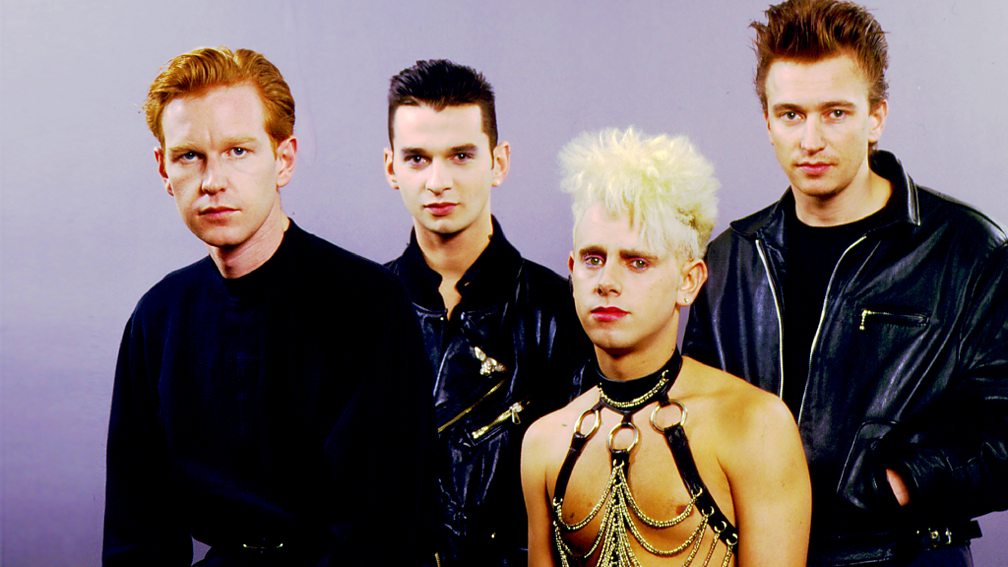
Above - Depeche Mode (1990) and in 1988. Leather and 'bondage' fashion is significant of the band and black leather was something that fans were able to associate with the band and even followed the style themselves, as seen in the film 101.

This further highlights the importance of star image and fan interaction.
Narrative & Performance
Songs don't provide a complete narrative. Songs only provide parts of the meaning of the song and we make up our own opinions of the meanings we associate to the songs. Goodwin states that music videos should ignore common narrative, as it is important in their role of advertising to do so. Music videos should have coherent repeatability. Narrative and performance work hand in hand, making it easier for the audience to watch over and over without losing interest. At least, for a passive audience anyway. The artist acting as both narrator and participant of the music video helps to increase the authenticity of the video. However, lip syncing and other mimed actions to follow the song much remains the main common convention of music videos.
Technical Aspects
These are shot types, camera angles, mise-en-scene, editing and other special effects.
Music videos often have editing that follows the beat/pace of the song, close-ups and quick editing cuts for dance sequences or close-up shots for music videos that have sexual themes. Linking into star image, lots of close-ups of the artist's faces are used to allow the audience to identify with their favourite artist. Mise-en-scene can also link into star image because the artist may be wearing clothes of their trademark style. Mise-en-scene also needs to look professional and of a high quality.
Relationship between the Song and the Visuals
There are 3 ways in which music videos work to promote a song:
-Illustrate
Music videos can use a unique set of images to illustrate the meaning of the lyrics and genre.
-Amplify
This is similar to repeatability. Meanings and effects are manipulated, being constantly shown throughout the video and drummed into the audience's vision.
-Disjuncture
This is when the meaning of the song is completely ignored and a visual that is irrelevant to the song is used.
Bibliography
Goodwin, A. (1993). Dancing in the distraction factory. London: Routledge.
This is the first step, in which the music structure is analysed, allowing an understanding of the verses and chorus to be made. Second, the voice of the song must be analysed. The artists' voice can be incredibly unique, providing a sense of identification for the artist or allowing a trademark sound, linking into their star image. Thirdly, Goodwin notes the artists' mode of address. Songs can be perceived as stories and the artist is the storyteller. An example of this is Babooshka by Kate Bush, as attached below:
Star Image
This is when the artist has a significant look that can be seen in many different types of their media whatever it is. It is a vital aspect to music videos as it allows people to associate different traits to certain artists. Meta narrative displays the artist's development over time and plays an important part in the music video production process.
Examples are:
Above - Depeche Mode (1990) and in 1988. Leather and 'bondage' fashion is significant of the band and black leather was something that fans were able to associate with the band and even followed the style themselves, as seen in the film 101.
This further highlights the importance of star image and fan interaction.
Narrative & Performance
Songs don't provide a complete narrative. Songs only provide parts of the meaning of the song and we make up our own opinions of the meanings we associate to the songs. Goodwin states that music videos should ignore common narrative, as it is important in their role of advertising to do so. Music videos should have coherent repeatability. Narrative and performance work hand in hand, making it easier for the audience to watch over and over without losing interest. At least, for a passive audience anyway. The artist acting as both narrator and participant of the music video helps to increase the authenticity of the video. However, lip syncing and other mimed actions to follow the song much remains the main common convention of music videos.
Technical Aspects
These are shot types, camera angles, mise-en-scene, editing and other special effects.
Music videos often have editing that follows the beat/pace of the song, close-ups and quick editing cuts for dance sequences or close-up shots for music videos that have sexual themes. Linking into star image, lots of close-ups of the artist's faces are used to allow the audience to identify with their favourite artist. Mise-en-scene can also link into star image because the artist may be wearing clothes of their trademark style. Mise-en-scene also needs to look professional and of a high quality.
Relationship between the Song and the Visuals
There are 3 ways in which music videos work to promote a song:
-Illustrate
Music videos can use a unique set of images to illustrate the meaning of the lyrics and genre.
-Amplify
This is similar to repeatability. Meanings and effects are manipulated, being constantly shown throughout the video and drummed into the audience's vision.
-Disjuncture
This is when the meaning of the song is completely ignored and a visual that is irrelevant to the song is used.
Bibliography
Goodwin, A. (1993). Dancing in the distraction factory. London: Routledge.
Carol Vernallis - Understanding and Explanation
Carol Vernallis' theory focuses on 4 important concepts that all relate to how music videos are constructed. These concepts are:
- Narrative
- Editing
- Camera framing/movement
- Digesis
Narrative
This is where the music video is a visual response to the music. Basically meaning, whatever is happening in the lyrics, it will be reflected on screen as part of the video's narrative. There isn't necessarily a balance between the narrative and performance of the song. Often, the narrative isn't complete. It might not make as much sense as a full-length film would. It might appear partial or fragmented, making the music video appear disjointed. Due to this, there often isn't a clear resolution at the end. This might leave the audience asking questions about the video. A final point to make about the narrative part of this theory is that there may be a clear narrative running throughout the music video, but it will be presented in a more montage style rather than in one continuous sequence. This is mainly because music videos are a lot shorter and have lesser budgets.
Editing
All music videos follow the same editing techniques: jump cuts, cutting with the lyrics, graphic matches, editing on the beat, changes in pace, etc. In most music videos, the editing matches the beat of the song. The video may break the rules of continuity editing, which is a clear convention of music video editing. The editing may become 'foregrounded' - the edits will be obvious to draw attention to themselves as opposed to invisible, continuity editing.
An example of editing at the pace of a song can be seen in Ayumi Hamasaki's Appears:


 This is a good example because a screen wipe effect is used during the chorus to the pace of the song's beat. The song has a walking-pace-like beat, in which is mimicked with the editing pace, movement of the camera and speed of Ayumi's movement.
An example of editing at the pace of a song can be seen in Ayumi Hamasaki's Appears:


Camera framing/movement
Extreme shot types are prominent in music videos, such as extreme long-shots and extreme close-ups. Within music videos, specific styles of camera framing and movement are conventional to the specific videos. The camera may move in time with the lyrics or music.
A good example of a consistent camera style is with PJ Harvey's This Is Love:


The camera style in this music video is very handheld and shaky. It changes from long-shots to closeups throughout the video, but the style of filming is consistent. It matches with the upbeat-ness of the music and the ruthless feelings of love in the lyrics.
Digesis
A digesis is the narrative or plot. It could be revealed quite slowly in music videos. Actions are often left unfinished or aren't shown to be completed (due to the short amount of time allowed in a music video), so there often are gaps between the narrative and performance. There are often repetitions of narrative elements in music videos.
Bibliography
Vernallis, C. (2004). Experiencing music video. New York: Columbia University Press.
A good example of a consistent camera style is with PJ Harvey's This Is Love:


The camera style in this music video is very handheld and shaky. It changes from long-shots to closeups throughout the video, but the style of filming is consistent. It matches with the upbeat-ness of the music and the ruthless feelings of love in the lyrics.
Digesis
A digesis is the narrative or plot. It could be revealed quite slowly in music videos. Actions are often left unfinished or aren't shown to be completed (due to the short amount of time allowed in a music video), so there often are gaps between the narrative and performance. There are often repetitions of narrative elements in music videos.
Bibliography
Vernallis, C. (2004). Experiencing music video. New York: Columbia University Press.
Tuesday, March 5, 2019
Music video analysis: Barrel of a Gun by Depeche Mode
The video begins with Depeche Mode's singer Dave Gahan lying on a bed in a foetal-like position, to then roll over onto his side. The room is mainly dark with bright accents from the bedding and wall art. There are multiple different shots of him as he rolls around in bed, looking uncomfortable. Match-on-action editing is then used to transition him lying in bed to show him lying in a bathtub. This is symbolic to Dave's recent heroin overdose which was heavily documented in music media at the time, specifically the overdose in which he died for 2 minutes. It is also symbolic of the fact that the band hadn't made any music for 4 years which was a much larger gap between an album than people were used to from the band. At the time, people assumed that they had split up and were no longer going to be releasing music as Alan Wilder departed in 1995 and both Dave and Martin were dealing with substance abuse issues. It was rumoured that Songs of Faith and Devotion was going to be their last. This music video was like a big comeback for them, which is why there are a lot of particular themes in it.
The acting from Dave is very much what you'd expect from someone addicted to heroin. As I stated initially, him lying in the foetal position could be to represent a kind of 'rebirth' for him and the band post-drug-and-Alan-departure. It could also be to symbolise how much him as a person had been reduced, simply to a baby.
The editing throughout this video is rather fast-paced, which is unfitting with the music, as it is rather slow paced, bass-y and grungey. But, the editing is fast paced to emphasise how intense and fast-paced it was when the individual band member's lives were going off the rails.
The mise-en-scene for the first half of the video is in a very grim, dark and grungy-looking It is simply just to symbolise the bad, dirty place that Dave was in prior to this.
In the second part of the music video, director Anton Corbjin put a cardboard tube around the outside of the camera lens. It is not confirmed as to why he did this, but from my perspective, it allows all shots from this point onwards look as though the person in the frame is trapped in a small tunnel, which again, just symbolises the band's struggles at the time. The use of a handheld camera is also done to emphasise a sense of disorientation.
It is hard to distinguish if the purpose of this music video is purely for aesthetic purposes, to provide the band with a new rock n roll look or if it is to provide the audience with an insight into the band's private lives behind the music. This is due to the music video fitting into Anton Corbjin's auteur style, as many of his photography projects look similar to this music video:


Friday, February 1, 2019
Music Video Inspiration
A style of music video I personally like is when it is predominantly shot above the shoulders, showing the singer's facial expressions (close-up) and not much else. It is simplistic, minimalistic and allows the music to carry emotion whilst refraining from pushing a narrative that could hinder the meaning that the audience takes from the song. It also allows a sense of star appeal which is beneficial.
Examples of this type of music video are as followed:
Nothing Compares 2U - Sinead O'Connor (1990)
Du Riechst So Gut - Rammstein (1995), heavily inspired by Sinead O'Connor's video
Another example that I really like is Round & Round by New Order:
This music video doesn't have any singing as none of the models from the music video are in New Order or are even musicians at all. It is so simplistic and really emphasises New Order's anonymity (despite them not actually being actively anonymous), allowing the audience to focus more on the song. In a way, the music video is very relevant to the subject of the song as the song is about putting on a front and pretending to be something that you aren't - "The picture you see is no portrait of me / It's too real to be shown to someone I don't know". It shows models without make-up and without any flashy 80s clothing, so they are their real selves and it is quite personal. Ideally I would like to use this video as heavy inspiration and maybe perhaps recite it as homage or postmodernism.
Examples of this type of music video are as followed:
Another example that I really like is Round & Round by New Order:
Tuesday, January 29, 2019
Pagan Poetry by Björk - music video analysis
The meaning I take from this song is about forbidden love; a woman falling in love with someone who is toxic and makes the protagonist want to 'hurt myself again'. The singer knows that this person that she is in love with is bad and that he makes things worse for her - but her love is so blind that she wants that to happen. On the surface, the relationship looks healthy and okay, 'but the darkest pit in me' = deep down it really isn't.
The music video shows distorted shots that, on the surface, are hard to really work out what it is. It is something moving. One of the shots is a closeup shot of Bjork's mouth singing, then changes to a clear close up with a lens similar to a fisheye but not quite. It then transitions to a close up shot of her face, expressions being that of a sexual nature. The music video has heavily sexual connotations, suggesting that the song is about a relationship being knowingly toxic but putting yourself through it because the sexual relationship holds you back.
The meaning of this song and video is polysemic like most music videos. Another meaning I took from this was that the relationship is possibly abusive in some way, which is why a lot of the imagery is centring on pain, e.g the close-up shots of body piercings. Maybe not an abusive relationship, but more of a BDSM relationship, as the video is so overly sexual.
Something interesting about this music video is the fact that it is overly sexual but does not sexualise Bjork in a misogynistic way. There is a lot of nudity and sexual imagery but it does not objectify or fetishise Bjork at all. The mid-shot of her, hair blowing in the wind, wearing an Alexander Wang dress with her chest exposed is more emotional than sexual. The positioning of the camera allows her facial expressions whilst she sings be the focal point, rather than her breasts. It's like a reversal of the fragmentation theory.
Wednesday, September 12, 2018
Subscribe to:
Posts (Atom)