Search This Blog

Monday, March 11, 2019

Andrew Goodwin's music video theory

According to Goodwin, music videos have 5 key aspects:
  • Relationship between the song and the visuals
  • Narrative and performance of the song
  • Technical aspect of the music video
  • Star image from the protagonist (celebrity musician) with a lot of shots of the musician to make them the centre of attention
  • Thought through beat (seeing what the lyrics mean in the audience's head - this is the first step)
Thought through Beat
This is the first step, in which the music structure is analysed, allowing an understanding of the verses and chorus to be made. Second, the voice of the song must be analysed. The artists' voice can be incredibly unique, providing a sense of identification for the artist or allowing a trademark sound, linking into their star image. Thirdly, Goodwin notes the artists' mode of address. Songs can be perceived as stories and the artist is the storyteller. An example of this is Babooshka by Kate Bush, as attached below:
Though the music video doesn't follow the narrative of the song, the song is still telling a story.

Star Image
This is when the artist has a significant look that can be seen in many different types of their media whatever it is. It is a vital aspect to music videos as it allows people to associate different traits to certain artists. Meta narrative displays the artist's development over time and plays an important part in the music video production process.
Examples are:
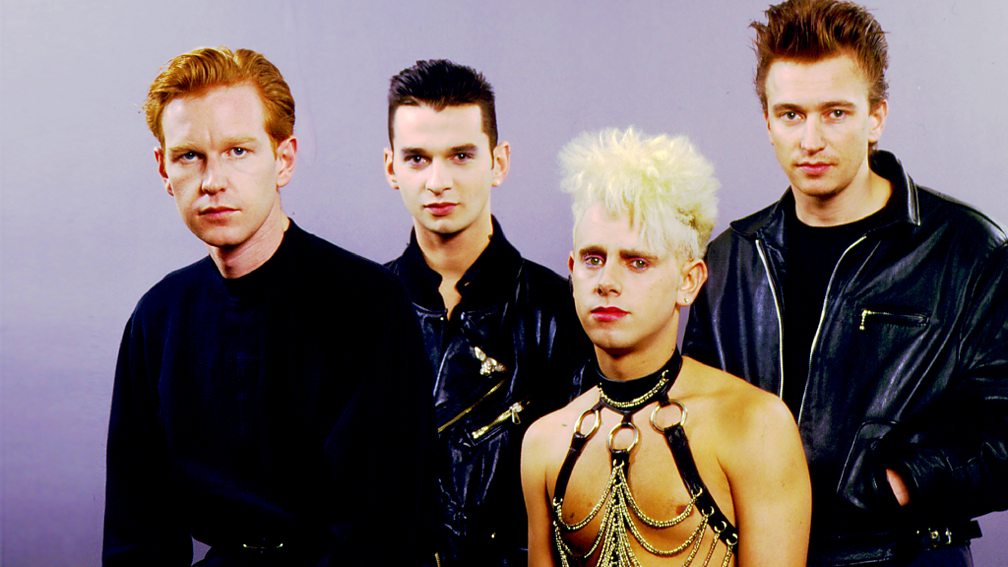
Image result for depeche mode 1990sRelated image
Above - Depeche Mode (1990) and in 1988. Leather and 'bondage' fashion is significant of the band and black leather was something that fans were able to associate with the band and even followed the style themselves, as seen in the film 101.
Image result for depeche mode fans 101
This further highlights the importance of star image and fan interaction.

Narrative & Performance
Songs don't provide a complete narrative. Songs only provide parts of the meaning of the song and we make up our own opinions of the meanings we associate to the songs. Goodwin states that music videos should ignore common narrative, as it is important in their role of advertising to do so. Music videos should have coherent repeatability. Narrative and performance work hand in hand, making it easier for the audience to watch over and over without losing interest. At least, for a passive audience anyway. The artist acting as both narrator and participant of the music video helps to increase the authenticity of the video. However, lip syncing and other mimed actions to follow the song much remains the main common convention of music videos.

Technical Aspects
These are shot types, camera angles, mise-en-scene, editing and other special effects.
Music videos often have editing that follows the beat/pace of the song, close-ups and quick editing cuts for dance sequences or close-up shots for music videos that have sexual themes. Linking into star image, lots of close-ups of the artist's faces are used to allow the audience to identify with their favourite artist. Mise-en-scene can also link into star image because the artist may be wearing clothes of their trademark style. Mise-en-scene also needs to look professional and of a high quality.

Relationship between the Song and the Visuals
There are 3 ways in which music videos work to promote a song:
-Illustrate
Music videos can use a unique set of images to illustrate the meaning of the lyrics and genre.
-Amplify
This is similar to repeatability. Meanings and effects are manipulated, being constantly shown throughout the video and drummed into the audience's vision.
-Disjuncture
This is when the meaning of the song is completely ignored and a visual that is irrelevant to the song is used.

Bibliography
Goodwin, A. (1993). Dancing in the distraction factory. London: Routledge.

Carol Vernallis - Understanding and Explanation

Carol Vernallis' theory focuses on 4 important concepts that all relate to how music videos are constructed. These concepts are:
  • Narrative
  • Editing
  • Camera framing/movement
  • Digesis
Narrative
This is where the music video is a visual response to the music. Basically meaning, whatever is happening in the lyrics, it will be reflected on screen as part of the video's narrative. There isn't necessarily a balance between the narrative and performance of the song. Often, the narrative isn't complete. It might not make as much sense as a full-length film would. It might appear partial or fragmented, making the music video appear disjointed. Due to this, there often isn't a clear resolution at the end. This might leave the audience asking questions about the video. A final point to make about the narrative part of this theory is that there may be a clear narrative running throughout the music video, but it will be presented in a more montage style rather than in one continuous sequence. This is mainly because music videos are a lot shorter and have lesser budgets.

Editing
All music videos follow the same editing techniques: jump cuts, cutting with the lyrics, graphic matches, editing on the beat, changes in pace, etc. In most music videos, the editing matches the beat of the song. The video may break the rules of continuity editing, which is a clear convention of music video editing. The editing may become 'foregrounded' - the edits will be obvious to draw attention to themselves as opposed to invisible, continuity editing.
An example of editing at the pace of a song can be seen in Ayumi Hamasaki's Appears:
This is a good example because a screen wipe effect is used during the chorus to the pace of the song's beat. The song has a walking-pace-like beat, in which is mimicked with the editing pace, movement of the camera and speed of Ayumi's movement.

Camera framing/movement
Extreme shot types are prominent in music videos, such as extreme long-shots and extreme close-ups.  Within music videos, specific styles of camera framing and movement are conventional to the specific videos. The camera may move in time with the lyrics or music.
A good example of a consistent camera style is with PJ Harvey's This Is Love:
The camera style in this music video is very handheld and shaky. It changes from long-shots to closeups throughout the video, but the style of filming is consistent. It matches with the upbeat-ness of the music and the ruthless feelings of love in the lyrics.

Digesis
A digesis is the narrative or plot. It could be revealed quite slowly in music videos. Actions are often left unfinished or aren't shown to be completed (due to the short amount of time allowed in a music video), so there often are gaps between the narrative and performance. There are often repetitions of narrative elements in music videos.

Bibliography
Vernallis, C. (2004). Experiencing music video. New York: Columbia University Press.

Tuesday, March 5, 2019

Music video analysis: Barrel of a Gun by Depeche Mode


The video begins with Depeche Mode's singer Dave Gahan lying on a bed in a foetal-like position, to then roll over onto his side. The room is mainly dark with bright accents from the bedding and wall art. There are multiple different shots of him as he rolls around in bed, looking uncomfortable. Match-on-action editing is then used to transition him lying in bed to show him lying in a bathtub. This is symbolic to Dave's recent heroin overdose which was heavily documented in music media at the time, specifically the overdose in which he died for 2 minutes. It is also symbolic of the fact that the band hadn't made any music for 4 years which was a much larger gap between an album than people were used to from the band. At the time, people assumed that they had split up and were no longer going to be releasing music as Alan Wilder departed in 1995 and both Dave and Martin were dealing with substance abuse issues. It was rumoured that Songs of Faith and Devotion was going to be their last. This music video was like a big comeback for them, which is why there are a lot of particular themes in it.
The acting from Dave is very much what you'd expect from someone addicted to heroin. As I stated initially, him lying in the foetal position could be to represent a kind of 'rebirth' for him and the band post-drug-and-Alan-departure. It could also be to symbolise how much him as a person had been reduced, simply to a baby.
The editing throughout this video is rather fast-paced, which is unfitting with the music, as it is rather slow paced, bass-y and grungey. But, the editing is fast paced to emphasise how intense and fast-paced it was when the individual band member's lives were going off the rails.
The mise-en-scene for the first half of the video is in a very grim, dark and grungy-looking It is simply just to symbolise the bad, dirty place that Dave was in prior to this.
In the second part of the music video, director Anton Corbjin put a cardboard tube around the outside of the camera lens. It is not confirmed as to why he did this, but from my perspective, it allows all shots from this point onwards look as though the person in the frame is trapped in a small tunnel, which again, just symbolises the band's struggles at the time. The use of a handheld camera is also done to emphasise a sense of disorientation.

It is hard to distinguish if the purpose of this music video is purely for aesthetic purposes, to provide the band with a new rock n roll look or if it is to provide the audience with an insight into the band's private lives behind the music. This is due to the music video fitting into Anton Corbjin's auteur style, as many of his photography projects look similar to this music video:
Image result for anton corbijn pj harveyImage result for anton corbijn bjork


Wednesday, February 13, 2019

Andy Warhol's screen tests

"The true test of a screen test subject, writes Weingart, is “not just the capacity to turn oneself into a living picture; rather, it is the capacity to bear the gaze of the camera.” This gaze could empower or upset its subjects, some of whom came out of the experience feeling either exhilarated and star-like or deflated and broken down. Their engagement with the gaze took many forms, such as “the luxurious exhibition of oral activities” like eating or smoking that played with the erotics of being stared at."

Thursday, February 7, 2019

Possible song choices

Regardless of what song I choose, my music video will follow the same premise - expressionless, natural looking girls in a studio with a projection overlay of the artists performing the songs and visuals relevant to the music that is not my own.
Depeche Mode - The Bottom Line
I feel that the song is nicely slow paced and quite ambient therefore it fits my concept very well. The use of lyrics like 'you' mean that the song is very personal and would be relevant to my music video as there is a prominence of female models.
The Beatles - I Want You (She's So Heavy)
Like The Bottom Line, this song uses the word 'you' and 'she' consistently throughout so it is relevant to my use of female models. Also, the minimalistic lyrics of this song will be reminiscent of the minimalistic idea for my music video. The song also has quite an eerie tone/subject to it, and my music video could be seen as a type of scopophilia, which this song definitely suits.
New Order - Fine Time
I would really like to use this song but I feel as though, due to the fact that my main inspiration is already a New Order song, it would seem lazy and unoriginal of me. The fast pace and upbeat acid- sounds of this song would work great with a projection and the lyrics would again be appropriate with the female models.
Apex Twin - produk 29 [101]
This song is appealing because I like it. There are no lyrics which makes it appealing as the models will not be singing any lyrics, therefore it would fit well. it is also one of aphex twin's calmer tracks, which would fit in with the visuals. I also like the sampling towards the end of the song of the woman talking about going to a club etc which would fit in great with the projection if I could find footage of where the sample is from.
Kanye West - Runaway
The main appeal for this song is to make my work more personal as this is quite an important song to me. It would allow me to create a more emotional and personal piece as opposed to a completely objective piece of work. It would allow me to use my own content for the projections, as I would use pictures from my life and things relative to the song's meaning. However, that in itself makes use of this song unappealing as I personally like it more when music remains subjective and without the music video forcing a particular meaning onto the audience.

Headshot moodboard


Above is a moodboard of images I have compiled of celebrity headshots. All of these except for the Beatles ones are the kind of headshots I want to use in my music video - not posey, lacking of expression, lacking of any background distraction and in a way, quite raw. I want the headshots in my music video to have girls lacking of makeup and not being so drastically posey as I want to keep that sense of rawness and reality in my music video as it goes completely against the current music video trends of big budget over the top performances (k-pop, mainstream American pop, etc). As pretentious as it may sound I would like my video to be a celebration of what people actually look like.

Projection moodboard

I plan to use a projection overlay throughout my music video over the models headshots to allow videos and images of the actual musicians through the use of found footage to add another layer to the video. This is to prevent the music video being purely just models - I would like to add something more to it and it is an aesthetically pleasing effect. I got my inspiration for this from Depeche Mode's music video Stripped: